Swastika Night
Katharine Burdekin
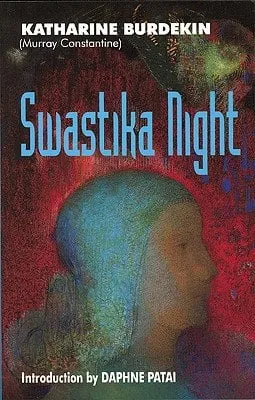
Little disclaimer, while I don't outright spoil any story beats in this book, I do "spoil" some of the worldbuilding and ideas that are brought up which in my opinion hold more weight in this book than the story itself, so keep that in mind.
A friend of mine was reading this book a while back, which prompted me to read it myself so we could discuss it. This book is mentioned here or there as a hidden gem of dystopian novels the likes of 1984 and Brave New World, and something funny I've noticed in multiple places online over the years is that despite this novel being referred to as feminist, men that hate women tend to like it.. or like, "respect" it. I'll theorize on why that is at the end of the review.
Swastika Night is an alternative history novel written in 1937, set almost a whole millennium in the future. It explores a world in which the Nazis have won and now command over one half of the world (the other half being under... Japan's control!). Hitler is worshipped as a mythical long blond haired 7 feet tall CHAD god figure and has replaced all major religion, women have been reduced to cattle living in small gated stables almost, Christians are hated and persecuted but allowed to exist and almost all books have been burned, resulting in a collective loss of history and cultural knowledge.
I'll first start with the bad, the main thing being - I think I know why this book isn't that popular. It's just not that great of a fiction book. The story is very sparse, it hardly develops before ending in a weak, unsatisfying whimper. All of the juicy bits come from dialogue between two characters, and frankly, even the juicy bits aren't that amazingly executed because despite this book being an alternative history story all they do in the dialogue is relate themselves to the world we live in which feels lazy narratively. The characters also aren't the best. This book was clearly written as a way for the author to express an idea and it felt like this desire to express the idea overpowered anything else lmao. And also, I know that it's a product of a certain political climate, but considering the author is British, all the Brit praising in the book felt a bit like taping oneself on the shoulder and it wasn't exactly subtle... Like hey, maybe the Nazis won and we're considered to be untermensch, but the Cool Important Nazi Guy says we're like, really intelligent and spunky and amazing and cool and inquisitive and brave and... I get that morale probably had to be lifted up but lmao.
Despite all of this though, I do think some parts of this future world brought up interesting ideas. I especially enjoyed the part where women stopped birthing female children because the trauma inflicted on women has been so extensive that even their genes decided it's time for the human race to end, it's a reminder that no matter how much men oppress women and try to control reproduction, it'll never be guaranteed. And the nice irony with men that were overjoyed any time a woman would birth "man-children", while the higher ups were slowly starting to see the writing on the wall and what it would mean for the incredible German race. The system women have been subjected to in the book is very exaggerated and satirized, but it is based on some real ideas presented by Otto Weininger that had absolute bangers such as:
“Woman is soulless and possesses neither ego nor individuality, personality nor freedom, character nor will.”
Our buddy boy genius Weininger based his views of women on Plato and Aristotle, so this is nothing new! In a couple of parts the discussion of the female condition was brought up, such as how women's great failure has been asking for "mere" equality out of modesty, or how since the dawn of patriarchy we have accepted en masse that men are superior and everything we do reflects that, instead of us believing ourselves superior because that is a silent existential prerogative of every single living being, to believe itself to be the most superior. Maybe this argument in particular is a bit flimsy, but I think there's some merit in it, specifically the "silent" part.
No spoilers just me going on a tangent about myself xd
Specifically this idea of superiority struck a chord with me. I realized as I read this that I don't remember a time in my life, childhood or adolescence where I felt incredibly inferior to men in a way that I couldn't measure up to them. Maybe I lack confidence in a lot of areas in my life but ironically mentally I always deemed myself no weaker or different than any other human. It's this lack of awareness that has left me feeling sad and mainly CONFUSED at many points in my life because some boys and men around me growing up clearly saw me as inferior/lesser and ignored my existence because not only was I inferior, I wasn't romantically attractive/interesting. This used to trouble me a lot, especially once I started pretending to be a man online and this barrier suddenly disappeared, and maybe the reason why I was able to "ignore" much of the online womanhating around me is because I was in such deep, deep disagreement with it I couldn't even comprehend it as something people actually think and practice lmao. Idk. I'm not even sure myself!All the bleakness around women aside, there is some hilarity to be found in this book and it is of course it building on the homosocial nature of men in a highly patriarchal system. The way men are always looking for someone to rule over them and for them to be submissive to, but at the same time always having the security of knowing they're not at the bottom (women are) no matter if they're the untermesch, christians, peasants, whatever their role or stature is, the way how in a system where women are made to be as ugly as possible they divert their attraction to little boys and other men, the way in which according to their religion the God Thunderer "exploded" Hitler into existence because he was a male incapable of giving birth but he had to give life somehow (hint hint nod nod all abrahamic religions)...
Now, lastly, why do MenWhoHateWomen like this book? I think it's because women are hardly characters in the story lmao. All of the characters doing the thinking and talking are men, and it really is that simple sometimes. Many of the ideas being expressed in this book are commonly expressed in feminist theory, but because Burdekin published this under a male name, I suppose the book allowed itself to build a certain reputation and gain the respect of the Collective Male even after it was revealed the author was a woman, which from what I understood was revealed two whole decades after her death and by that point the reputation stayed.
All in all, this wasn't an amazing book in every aspect but it certainly has left a mark, even though it's so ridiculously exaggerated.