Flag
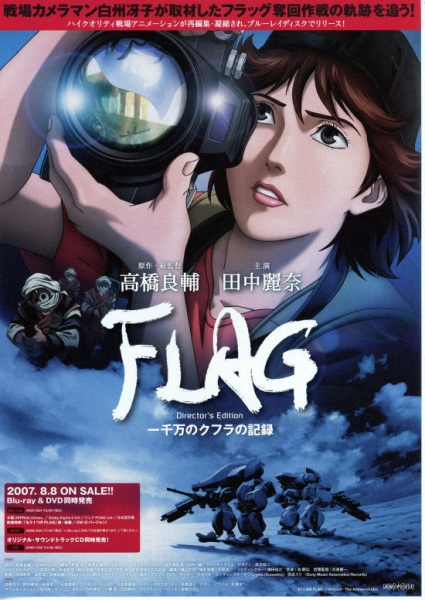
Third time's a charm, right? My quest for an interesting and short political drama anime has come to an end, and while Flag is my favourite of the three I watched, it's not astounding either.
In the world of anime, Flag really stands out. It's constructed to look like a found footage/documentary story, certainly something you don't see every day in the animation world. The art style is not typically anime, in fact I'd sooner compare it to western animation than to your average anime. It lacks that autistic overacting we all know and love. While it features a mandatory mecha, this is probably one of the most realistic implementations of a mecha in anime, if realism is something you're nuts about. I personally don't have issues with crazy nonsensical physics, in fact it can really do a lot to enhance the cool factor, but I enjoyed seeing this too for a change. The mechas overheat, they're pretty fragile, they can't really jump and move wherever and however they want. They basically function as stronger and cooler looking tanks in this universe.
Since this is a political drama, let me talk a bit about that. I think from a meta standpoint, this was handled in a (maybe unintentionally?) fascinating and even kind of cynical way.
Wait, let me backtrack a bit and do a tl;dr of the story. It's the year 20XX, somewhere close to our timeline. The main characters of the story are two journalists/photographers from Japan. Saeko, the one who most of the footage belongs to, and Keiichi, the narrator. Saeko is responsible for capturing an iconic image of a flag in a made up country ravaged by civil war located somewhere in... Asia. UN is involved in "peacekeeping". The flag gets stolen, and Saeko gets invited to document the special unit that is tasked with retrieving the flag, in the outskirts of that country. Meanwhile, Keiichi is located in the capital with most of the other journalists, narrating to us about what's been going on, which is interspersed with Saeko's footage of her getting to know the special units team and trying to capture the flag. Saeko is a bit naive, and also seems to be at a crossroads in her life - trying to decide what she does photography for. Keiichi is older and more experienced, so he provides the more seasoned perspective.
You can probably see where this is going, Saeko is placed into this special UN soldier unit and is getting to know them, and thus humanize them. UN as an entity is treated neutrally and even kind of negatively throughout the story through the lenses of the photographers. We get to see how they handle the press, how calculated their every move is, and how they're intruding in this foreign country. UN here very specifically represents the "western world" - signified through all of the members of the special unit. The terrorist groups within this country are funded by China and Russia, something that is known to us after a certain event takes place in the second half of the story. You can then read this conflict as a proxy situation wherein both the UN and the other side have ulterior motives (unrelated to the religious factions that started up the war), reminiscent of many other real life situations of the past, and today. Because of this, I find it interesting that this country is actually unnamed, contrary to the popular opinion. Because the truth of the matter is, it doesn't matter. Maybe this sounds cynical and heartless, but really, do the big boys care? All of the great powers are pretty out and open with using conflicts in smaller countries as a proxy war, as a way to test out their newest technologies and weapons, and I'm not even mentioning the other usual geopolitical interests, resource wars etc. And this is exactly what is happening in the anime. Distancing the story half a degree away, by keeping The Usual Suspects and obscuring the "victim" country seems like a choice that makes you pissed off at first, and like I said it might even be unintentional, but the obscuring works as a mirror held up to what's going on at any point in time for the past... hundred years.
We're not really too involved in the conflict and the conspiracies behind it, all we know is that there are two religious factions within this country, the crossroads of which meet right in the capital itself. The first faction is devoted to the god of destruction (it's the one with the terrorist) and the other to the god of rebirth, the members of the latter featured in the photograph Saeko took. With this the anime chose a simpler symbolic approach which I honestly did find a bit boring, yes yes one religion good, other religion bad and that's that.
The camera aspect was done really well imo. Animation wise, the angles, the fov changes, the distortion, shakiness or lack thereof, the changes in the camera UI that signify who is filming, use of cameras in the mechas and helicopters, so many little details that I think really made this look believable. I can forgive the characters recording their bar meetings, maybe for a paranoid journalist that wants to document their existence this isn't so far fetched.
Saeko and the special unit part of the story was... okay. I actually wasn't too enthralled by the story, nor the operation itself, but what did interest me was their relation with the constant lens filming them. You can see how each character reacts differently to it, and some of them are colder towards Saeko due to it. Most interestingly I like how Saeko had the most friction with the only fellow countryman in the unit. Because of her camera she is not a typical protagonist that observes. It adds an extra layer of awkwardness and makes Saeko feel like a nosy intruder, which is contrasted with her general presentation.
Out of all episodes my favourite was the one when Saeko got to exit the base and visit the nomadic doctor. It's a "calm before the storm" episode, and I think it was done really well.
I wasn't expecting the ending. I mean it's implied (implied is an understatement) in the beginning, but it still came as a surprise to me lol. I guess because I felt that way, it means I did end up emotionally connecting with the characters after all.
Overall... this anime does a lot of things well but I guess as usual the shortness takes away from it and works as a detriment in how connected and immersed you get with the story. I think one cour anime need to be executed extremely well to work, and in this one there was something crucial missing for me. Maybe smaller casts of characters would help more...